

In industrial environments, the last thing a production team wants is machine downtime caused by failures and corrective maintenance. Unexpected shutdowns increase costs and reduce efficiency. With this in mind, Resistências Paulista has gathered these “TEN TIPS,” since heaters play an essential role in many processes, and premature failure often creates bottlenecks and operational disruptions.
By following a few fundamental precautions, it is possible to significantly reduce heater-related problems, increase efficiency, and lower maintenance costs. Below are ten important recommendations to extend the service life and performance of these devices.
Tip 1 — Use Proper Temperature Control and Protection Systems
To ensure good performance and durability, the heater must operate with an appropriate control system. Every application should have at least a process temperature sensor (monitoring the material being heated) and a high-limit sensor (monitoring the heater sheath temperature).
The process sensor should be immersed in the fluid or installed inside a thermowell. For safety, it is recommended to use two systems: one for temperature control and another for safety limit protection.
PID controllers provide greater precision and faster response than On/Off controllers or thermostats, although they may have higher cost — and are not always necessary for processes that do not require high accuracy.
Ideally, the control system should maintain temperature within defined standards and include overheat protection.
Tip 2 — Protect the Heater Against Corrosion
Contamination is one of the main causes of premature heater failure. Since the element expands and contracts during thermal cycles, organic or conductive materials may form, leading to electrical arcing between coils or between the coil and grounded sheath.
Terminals must also be protected against dirt and moisture to prevent poor contact and short circuits. Keeping terminals clean and properly sealed significantly reduces these risks.
In corrosive fluid applications, consult corrosion compatibility charts to verify sheath material suitability.
Tip 3 — Prevent Dirt Buildup on the Heating Element
Deposits such as scale, residue, sludge, and crust reduce efficiency and force the heater to operate at higher temperatures, accelerating deterioration.
These accumulations should be removed regularly — or at least controlled — to ensure proper heat transfer to the fluid. Periodic cleaning prevents overheating and extends equipment life.
Tip 4 — Protect Terminals from Excessive Movement and High Temperatures
In machines with significant vibration or movement, heater terminals must be secured and protected to prevent breakage or mechanical damage.
When exposed to temperatures up to 260°C (500°F), fiberglass-insulated cables are recommended; above that, fiberglass with mica insulation is required.
Whenever possible, keep terminals away from high-temperature zones to avoid thermal degradation.
Tip 5 — Install Immersion Heaters Properly in Tanks
For tank heating, immersion heaters should be installed horizontally at the bottom to allow natural convective circulation of the fluid. Vertical installation should only be used when proper positioning is not possible.
Avoid placing the element too close to the tank bottom to prevent contact with sediment, which can cause overheating. Also, avoid confined areas that restrict fluid flow or trap vapor.
Tip 6 — Confirm Compatibility Between Sheath Material and Watt Density (W/cm²)
Proper selection of sheath material and watt density is essential to prevent premature failure.
• For low to medium temperatures: carbon steel, aluminum, silicone, etc.
• For high temperatures: stainless steel or special alloys.
As temperature increases, watt density must decrease to prevent oxidation and internal wire rupture.
For gas heating, selection depends on operating temperature and flow rate. For example:
Hydrogen allows higher watt densities but requires Incoloy 800*, while nitrogen can be heated using stainless steel 304. Adding fins and increasing gas velocity improves heat transfer.
For liquids, decisions depend on flow rate, density, temperature, and proper watt density — such as 1.4 W/cm² for fuel oil at 82°C and 9–15 W/cm² for water with copper sheath.
Tip 7 — Properly Size and Select the Heater
Power must be calculated according to actual process requirements, ensuring the On/Off operating cycle is appropriate.
In precision-fit applications, the bore or housing must be correctly specified to eliminate air gaps and guarantee efficient heat transfer.
Tip 8 — Avoid Long On/Off Cycles
Poorly configured On/Off cycles cause large temperature variations, resulting in excessive expansion and contraction of the resistive wire — leading to oxidation and premature breakage.
Thermostats often create this issue due to slow temperature response.
A better — though more costly — solution is using PID controllers with contactors or, ideally, solid state relays (SSR). These allow extremely fast switching (milliseconds), reducing thermomechanical stress and significantly increasing heater lifespan.
Tip 9 — Use the Correct Voltage
The applied voltage must match the heater’s rated voltage. Any increase or decrease changes power quadratically.
For example:
A 110 V / 2000 W heater connected to 220 V will operate at 8000 W — four times the rated power — causing immediate burnout and equipment damage.
Tip 10 — Properly Ground the System
All equipment using heaters must be properly grounded. Grounding protects both the installation and operators in the event of electrical faults and is an essential safety practice.
Need to Heat an IBC? Buy Heating Blankets from Paulista Heaters and Ensure Top Quality!
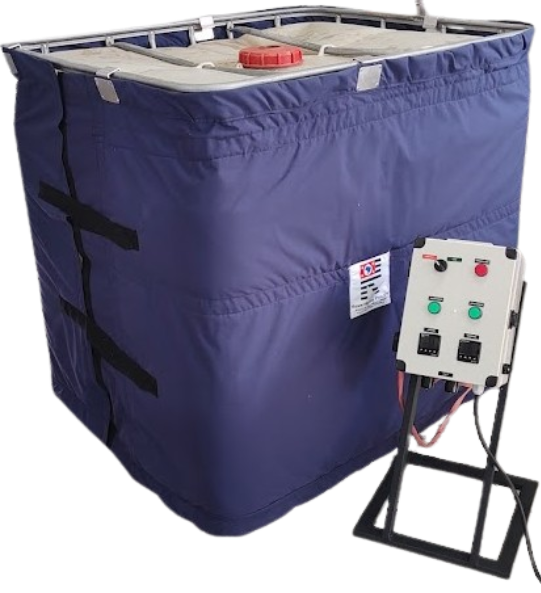
Perfect for Heating 1000L IBC Tanks. Learn More…